KomelKaur.com · Operating case study
Turning KomelKaur.com into a practice growth system
A product and growth architecture that joins search, assessments, AI guidance, bookings, payments, clinical workflows and first-party analytics.
A private psychology practice operated as a connected digital business, joining expert content, assessments, appointments, paid products and a role-protected clinical CRM.
Private practices, Expert-led businesses, Appointment platforms, Subscription services, Paid digital products, CRM-backed operations.
The starting point
The website was only the visible edge of the problem.
KomelKaur.com began with a harder problem than building a brochure website. A private practice needs qualified discovery, trust, safe self-assessment, booking, payment, clinical administration and follow-up to work as one system.
The build connected those jobs rather than buying traffic into a disconnected form. Every public page can create a useful next action, and every operational action can produce data for the next decision.
Because this is a mental-health product, growth could never come at the expense of clinical ethics, informed choice, privacy or safety. Assessments had to remain educational rather than diagnostic, AI had to stay within approved public information and low-risk actions, and sensitive records had to remain protected from marketing and public-product systems. Those constraints were foundational product requirements, not compliance added after launch.
What can be stated with confidence“The implemented system supports several revenue streams: individual sessions, couples sessions, session plans, paid assessment reports and paid two-person relationship assessments.”
The build story
Each decision removed friction from the next one.
Turn expertise into discovery
Create useful search pages and assessment tools around the real questions prospective clients ask.
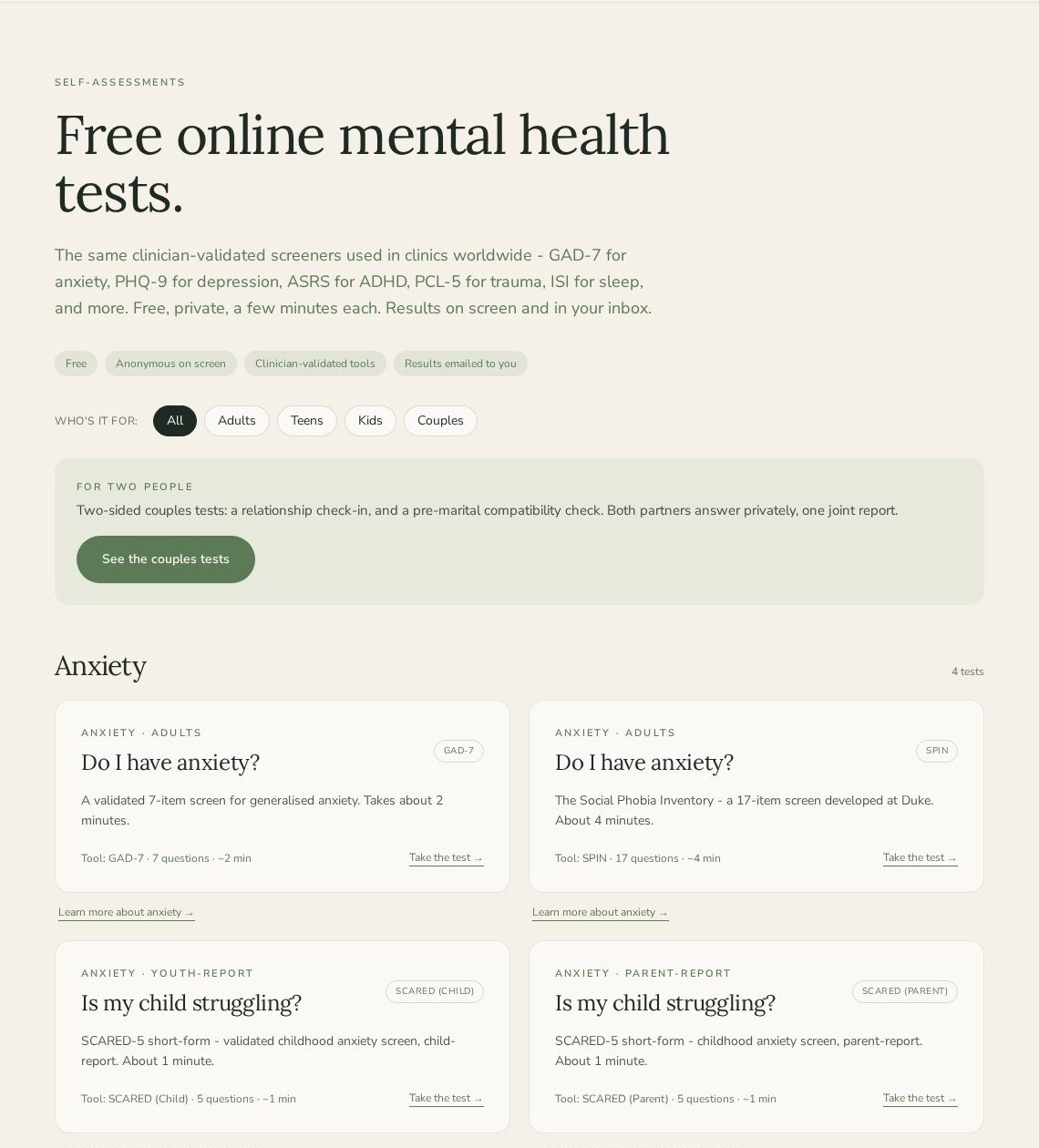
Search and AI-readable library. Topic, audience, city and country pages answer narrow intent with structured data, sitemaps and plain-language content. The intended effect was more qualified surfaces for non-brand discovery.
19 self-assessments. Scored tools cover anxiety, depression, ADHD, sleep, stress, trauma and relationship questions, with clear boundaries between educational screening and clinical diagnosis. The intended effect was immediate, responsible value before a visitor is asked to book.
Create safe, meaningful next steps
Move from a useful answer into an assessment result, guided choice, paid report or relevant session without presenting education as diagnosis or creating false certainty.
Paid deep reports. A completed free assessment can lead to a more detailed paid interpretation. The intended effect was a digital-product revenue path beyond appointments.
Two-person assessment flow. Each partner answers privately before a joint relationship report is assembled. The intended effect was a differentiated paid product for couples.
Connect transaction and delivery
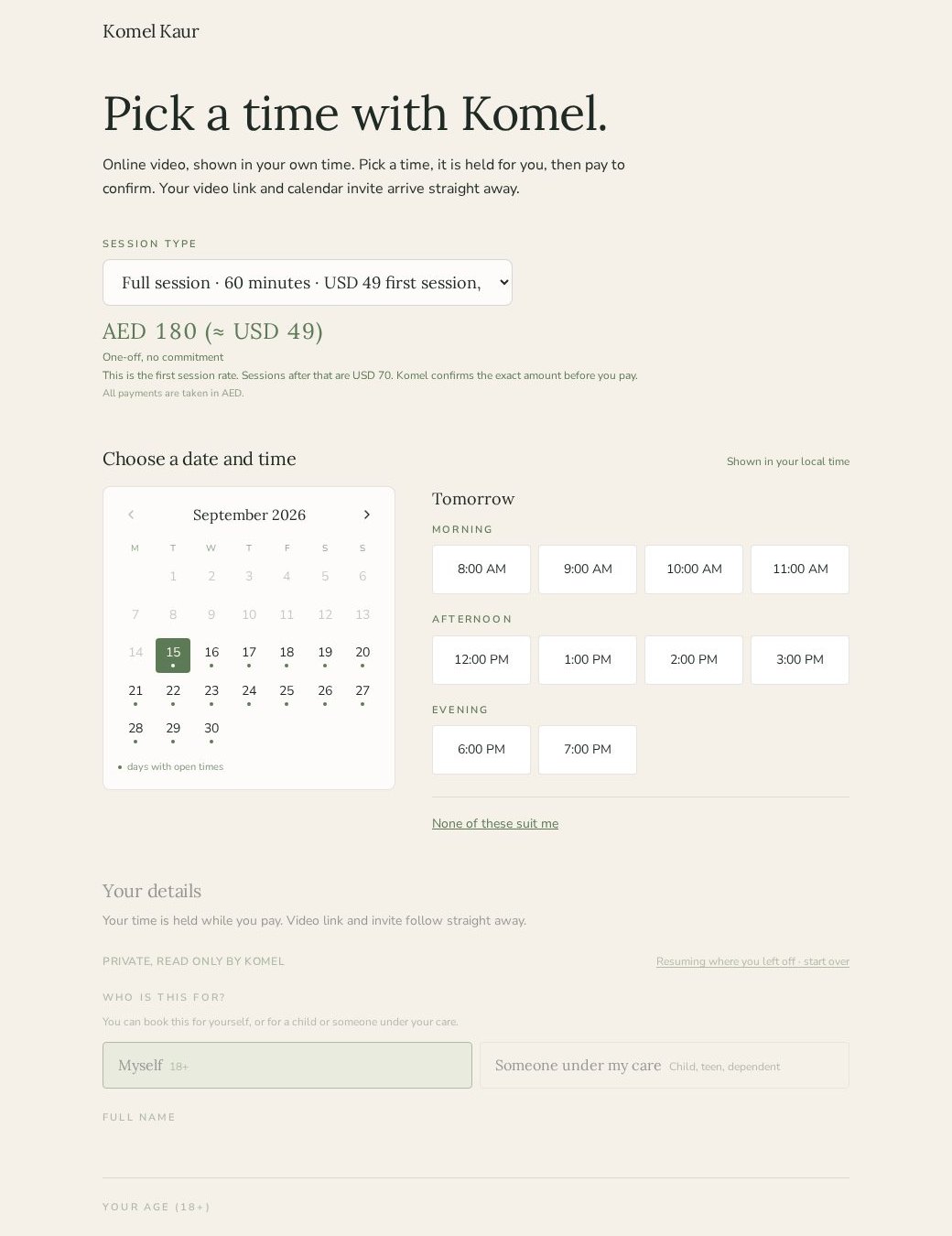
Join availability, slot holds, payment, calendar events, video links and reminders.
Bounded AI guidance. The assistant can explain approved public information, suggest assessments, show availability and open booking. It cannot diagnose, provide crisis care or access private client data. The intended effect was useful guidance without crossing clinical or privacy boundaries.
Live booking and payment. Availability, temporary holds, payment links, calendar events, video links and expiry handling work as one flow. The intended effect was less manual coordination between intent and a confirmed session.
Build the practice backend
Keep client records, sessions, MSE notes, follow-ups and operational context in one protected workspace.
Clinical CRM and MSE records. Role-protected client, booking, session, note, follow-up and Mental Status Examination records share one private operating context, separated from public acquisition tools. The intended effect was a complete service record with controlled access to sensitive information.
Lifecycle reminders. Incomplete payments, upcoming sessions and pending assessment partners can trigger relevant follow-up. The intended effect was fewer valuable journeys lost to inaction.
Close the learning loop
Connect first-touch source, funnel events, payment and revenue so the next build decision starts with evidence.
First-party growth analytics. Attribution, funnel steps, device context, payments and revenue are computed from owned operational events. The intended effect was growth decisions tied to paid outcomes rather than page views alone.
System map
One journey, not disconnected tools.
Discover starts with search intent, topic, location, audience and produces a relevant answer or assessment. Understand starts with assessment result or guided question and produces a useful and appropriate next step. Convert starts with session, report, plan or couples product and produces a paid or scheduled commitment. Deliver starts with calendar, video, records, mse and notes and produces a coordinated client experience. Retain starts with reminders, credits, plans and follow-up and produces a reason and path to continue. Improve starts with attribution, funnel, payment and revenue events and produces evidence for the next product decision.
Reading the evidence honestly
What this case supports, and what it does not.
“Can a specialist practice compound organic acquisition and revenue by connecting useful public tools to paid services and the back-office workflow?”
The live product architecture and revenue paths are verifiable in the build. This study does not publish revenue totals, traffic growth or conversion uplift because no approved analytics export was supplied. Those remain measurements to retrieve, not results to invent.
High-intent search architecture
Publish focused pages by therapy need, audience, city and country, with structured data, sitemaps and plain-text versions for AI systems. The signal to watch is non-brand impressions; indexed pages; qualified organic visits. The product contains topic, diaspora, city and country page systems plus sitemap and AI-readable content layers.
Free clinical self-assessments
Answer a high-intent question with an educational screening tool, explain its limits and offer an appropriate next step without implying a diagnosis. The signal to watch is test starts; completion rate; result-to-booking rate. Nineteen scored assessment types are registered, including anxiety, depression, ADHD, stress, sleep and relationship instruments.
Paid deep reports and two-person assessments
Add paid interpretive depth after a complete free result, and create a separate couples product that requires both participants. The signal to watch is report purchase rate; assessment revenue; session credit redemption. Payment-gated reports, couples invitations, joint report generation and session credit are implemented as distinct product flows.
AI assistant with bounded actions
Help visitors find a relevant test, understand the practice and open the booking picker without diagnosing, handling crises or exposing client data. The signal to watch is assistant-to-booking rate; useful tool calls; unsupported-answer rate. The assistant uses approved public knowledge and can list tests, show open slots and start the standard booking flow. It has no admin or client-data access, and its role is deliberately narrower than a clinician's.
Booking, calendar and payment orchestration
Join live availability, temporary slot holds, calendar events, video links, payment links and payment confirmation. The signal to watch is booking completion; payment completion; time spent coordinating. Google Calendar and Meet, MamoPay links, payment webhooks, expiry handling and reminders are connected in the operational flow.
Client CRM and Mental Status Examination records
Keep client, booking, session, clinical note and MSE context in one role-protected system. The signal to watch is admin time per client; missing records; follow-up completion. The admin system includes client records, sessions, structured MSE domains, notes, follow-ups, calendar and bookings.
First-party funnel and revenue analytics
Record acquisition source and each booking step, then report drop-off, payment and revenue from operational data. The signal to watch is step conversion; revenue by source; device drop-off; paid bookings. The admin analytics layer computes attribution, booking-funnel and revenue reports. Historical coverage begins only when tracking was enabled.
Lifecycle follow-up
Recover incomplete payments and remind clients or assessment partners when a useful action is still pending. The signal to watch is recovered payments; reminder completion; repeat booking. The system includes abandoned-payment alerts, session reminders and timed couples-assessment reminders.
No approved revenue or traffic export was supplied for this public study, so the page makes no numerical growth claim.
Implemented capability is not the same as customer adoption. Each product path still needs cohort-level reporting.
Attribution data is left-censored because visitors before instrumentation was enabled are not represented.
The assembled relationship assessment is evidence-informed and clinician-reviewed, but has not undergone its own independent validation study.
Self-assessments and AI guidance are not substitutes for diagnosis, therapy, emergency support or an independent clinical relationship.
Commercial optimization must not weaken informed choice, privacy, clinical judgment or the separation between sensitive care records and acquisition data.
What transfers to another company
Build one connected journey from search intent to useful action to paid outcome.
Do not hide all value behind a booking form. A complete free result can establish trust before a paid layer.
Treat the admin and clinical workflow as product work because it determines capacity and service quality.
Use first-party operational events to connect acquisition decisions to revenue rather than optimizing page views alone.
Bound AI to approved knowledge and safe actions instead of giving it broad access to sensitive systems.
In a mental-health product, ethics, privacy and safety are product architecture. They cannot be traded for conversion or added later.
The loop is simple: answer, then qualify, then monetize, then operate, then measure, then improve. The value comes from connecting those actions, not treating each as a separate feature.