HelpifyAE · Operating case study
Building HelpifyAE to profitability in six months
A field report on designing a lean home-services operation around faster administration, dependable fulfilment and contribution margin.
An on-demand home-services platform that has to coordinate customers, service categories, field teams, schedules and job economics in one operating loop.
Service marketplaces, Local-service platforms, Online B2C companies, Booking businesses, Operations-heavy startups, Repeat-service models.
The starting point
The website was only the visible edge of the problem.
HelpifyAE was built as an on-demand home-services business in the UAE. The operating problem was not simply generating bookings. Every booking also created work in qualification, scheduling, assignment, communication and issue resolution.
The product and operating model were therefore designed together. A feature only mattered if it reduced manual handling, improved service reliability, increased repeat use or protected the margin on each completed job.
What can be stated with confidence“The business became profitable within six months.”
The build story
Each decision removed friction from the next one.
Make demand structured
Turn an open-ended request into a service, location, timing and scope the team can act on.
Structured service catalogue. Clear service categories and request inputs make demand easier to route and price. The intended effect was less qualification work and cleaner booking data.
Transparent starting prices. Customers see an initial price signal before committing to the booking journey. The intended effect was stronger price expectation and better-qualified demand.
Make fulfilment visible
Give operators a shared view of assignment, status, ownership and the next action.
Scheduling workflow. Requested dates, availability and recurring-service needs become part of one operational record. The intended effect was faster assignment and fewer missed hand-offs.
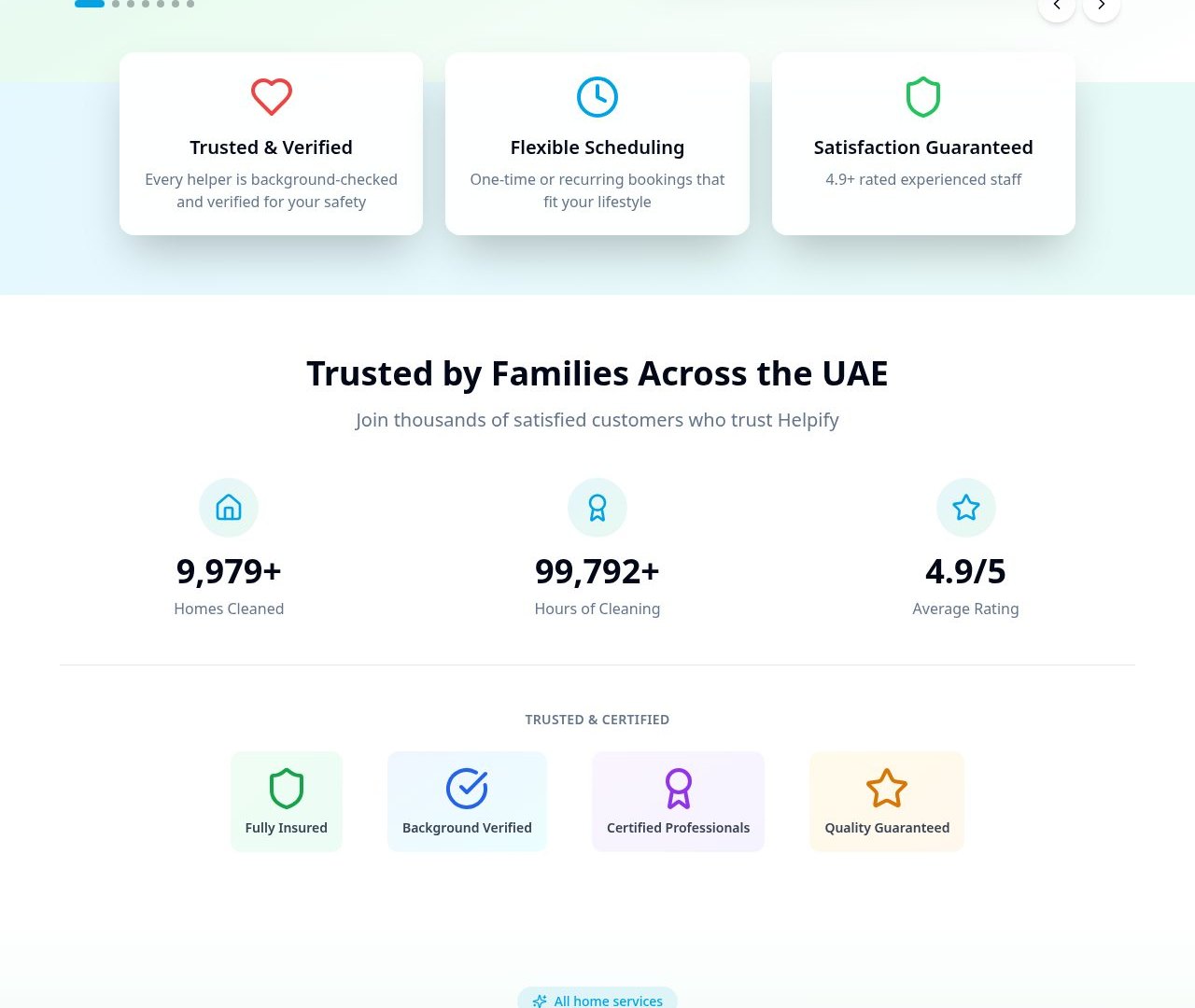
Trust and quality layer. Verification, insurance, ratings and service guarantees answer the risk questions that block a first booking. The intended effect was more confidence at the point of decision.
Protect the experience
Build trust, communication and quality checks into the customer journey rather than handling them ad hoc.
Operations queue. Requested, scheduled, active and completed work can be managed from a shared system rather than scattered messages. The intended effect was lower coordination load per completed job.
Service-status communication. Customers receive certainty at the moments that most often create inbound questions. The intended effect was fewer status queries and clearer expectations.
Manage for margin
Read revenue and fulfilment cost at job level, then focus capacity on work that can contribute profitably.
Job-level economics. Revenue, fulfilment cost, refund and rework risk are considered at completed-job level. The intended effect was a direct path from operations data to margin decisions.
Repeat-service path. Returning customers can book again without recreating all of the context from their first job. The intended effect was a lower-friction route to repeat revenue.
System map
One journey, not disconnected tools.
Discover starts with service need, location, trust questions and produces a clear category and reason to proceed. Book starts with scope, time, address, recurrence and produces a qualified service request. Dispatch starts with availability, skill, location, ownership and produces an assigned job with a next action. Deliver starts with status, communication, quality checks and produces a completed and traceable service. Learn starts with revenue, cost, issue and repeat signals and produces better pricing and capacity decisions.
Reading the evidence honestly
What this case supports, and what it does not.
“Can a service marketplace reach profitability quickly by using software to compress coordination cost while improving the customer experience?”
Profitability within six months is the verified company-level result. Historical event data was not preserved in a form that supports causal before-and-after claims for each feature. The feature-level rows therefore state the operational mechanism and metric that each intervention was designed to move, not an invented uplift.
Structured service request and scope capture
Collect the job type, location, timing and requirements before an administrator begins work. The signal to watch is admin minutes per qualified request; clarification messages per booking. Designed to remove avoidable back-and-forth. No retained time-series is available for a numerical claim.
Central booking and operations queue
Give the team one current view of requested, scheduled, active and completed work instead of fragmented messages. The signal to watch is time to assign; unassigned jobs; admin handling time. The operating benefit is directional: fewer hand-offs and less duplicated coordination.
Scheduling and job-status workflow
Make ownership and the next action visible for every request. The signal to watch is on-time arrival; reschedule rate; time from request to confirmation. The workflow was intended to improve timely service and reduce missed operational steps.
Customer communication at key service moments
Confirm the request, scheduled time and service status without relying on an administrator to remember each message. The signal to watch is inbound status queries; no-shows; customer response time. Customer benefit was faster certainty. Historical message-volume data is not available.
Service-level pricing and cost visibility
Review revenue and fulfilment cost at the job level rather than treating top-line bookings as success. The signal to watch is contribution margin; cost per completed job; refund or rework cost. This unit-economics discipline is consistent with the observed company-level outcome of profitability in six months.
Repeat-service path
Make a second booking easier than the first and retain the context needed to serve a returning customer. The signal to watch is repeat booking rate; days to second booking; revenue per customer. The mechanism supports lower acquisition cost over a customer's lifetime. A quantified uplift is not claimed.
The six-month profitability result is observed, but feature-level causal attribution is not available.
The study does not publish customer counts, revenue, margin or cohort retention because those figures have not been verified for publication.
Operational benefits are expressed through the metrics each system was designed to move, not estimated percentages.
What transfers to another company
In a service business, the product includes the internal operations console, not only the customer-facing booking flow.
Measure contribution margin on completed work. Gross booking value can hide an expensive operation.
Automate repeated coordination before adding headcount to absorb it.
A better customer experience and lower operating cost can come from the same intervention.
The loop is simple: capture, then coordinate, then deliver, then learn, then repeat. The value comes from connecting those actions, not treating each as a separate feature.